
Embedded development
designed to purpose,
from circuit to AI
We realize requirements that off-the-shelf products cannot meet with custom hardware and firmware. From circuit design and PCB layout to firmware development and onboard edge AI, we design with you step by step.
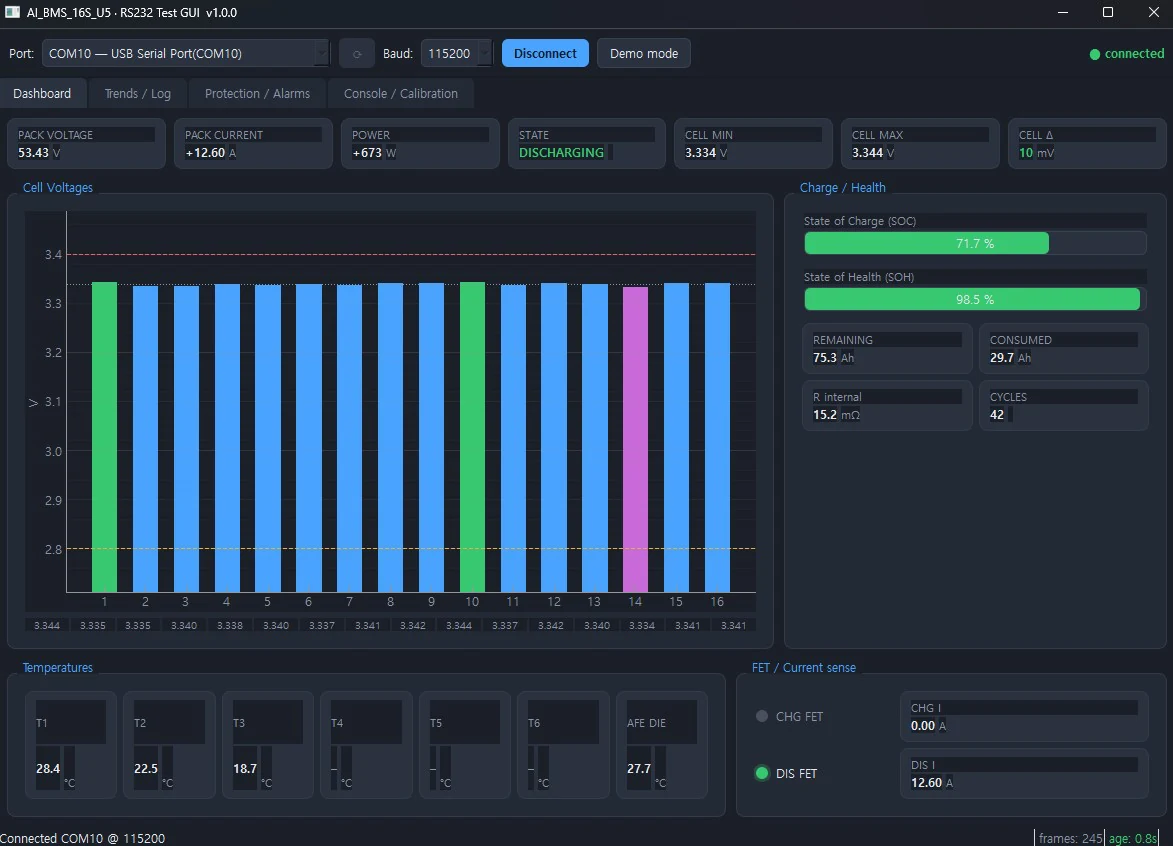
An embedded project we built in-house — the actual monitoring screen of the intelligent BMS (AI·BMS 16S). See the featured project →
→ firmware → mass production
can run on MCU/SoC
for industrial environments
to mass-production design
Consider custom development in these situations
Off-the-shelf products do not fit your environment
When special requirements such as size, power, interfaces, or certification make it difficult to use off-the-shelf products as is.
You want to run AI directly on the edge
You want to load a lightweight inference model onto an MCU or small SoC so the device itself can make decisions without a network.
You need IP protection and cost optimization
When you plan to mass-produce as your own product or supply via OEM after development, and need to reduce external dependency.
Step-by-step development process
from requirements to mass production
At each stage you review the deliverables before moving to the next. The scope can also be adjusted if you only need a prototype.
Requirements analysis
We organize the purpose, operating environment, interfaces, certification requirements, and budget and schedule. After reviewing similar cases, we finalize the development scope.
Circuit design and review
We proceed in the order of block diagram → schematic design → simulation verification. Component selection and the supply chain are also reviewed at this stage.
PCB layout and prototype
We lay out the PCB with EMI and thermal design in mind, then build a prototype. Signal integrity and power stability are verified by actual measurement.
Firmware development and AI onboarding
We develop RTOS-based firmware, the communication stack, and sensor drivers. If edge AI onboarding is needed, we also optimize lightweight models.
Validation and mass-production support
After functional and environmental testing, we prepare a mass-production design guide. When needed, we also support the certification (KC, CE, etc.) acquisition process.
Development scope
Hardware design — circuit and PCB
We handle the entire process, from MCU/MPU selection to peripheral circuit design, power and communication interface configuration, and PCB layout.
- Platform choices such as STM32, ESP32, NXP i.MX, and Raspberry Pi CM
- Mixed analog and digital circuit design
- Industrial wide-temperature (-40 to 85°C) design
- Layout with EMI/EMC design considerations
Firmware development — RTOS, drivers, and communication
We develop purpose-fit firmware, from the hardware abstraction layer to RTOS task design, sensor drivers, and the communication stack.
- Multitasking design based on FreeRTOS and Zephyr
- Modbus, CAN, MQTT, BLE, and Wi-Fi communication implementation
- Low-power sleep mode optimization
- OTA (over-the-air update) feature implementation
Edge AI onboarding
We optimize and load lightweight AI models onto the MCU or NPU so inference runs on the device itself, without a cloud connection.
- TensorFlow Lite / ONNX Runtime optimization
- Onboarding of anomaly detection, classification, and prediction models
- Optimization leveraging the NPU (Neural Processing Unit)
- Design balancing model accuracy, inference speed, and memory
Embedded projects we built in-house
Featured projects that EdgenomiX built in-house — from requirements definition through circuit, firmware, edge AI, and cloud integration.
Intelligent BMS — AI·BMS 16S
A battery management system that estimates and diagnoses each of 16 cells in real time using a Kalman filter (EKF) and on-device edge AI, and connects through to remote monitoring via MQTT on an ESP32 gateway. EdgenomiX developed the circuit, firmware, edge AI, and cloud integration in-house.
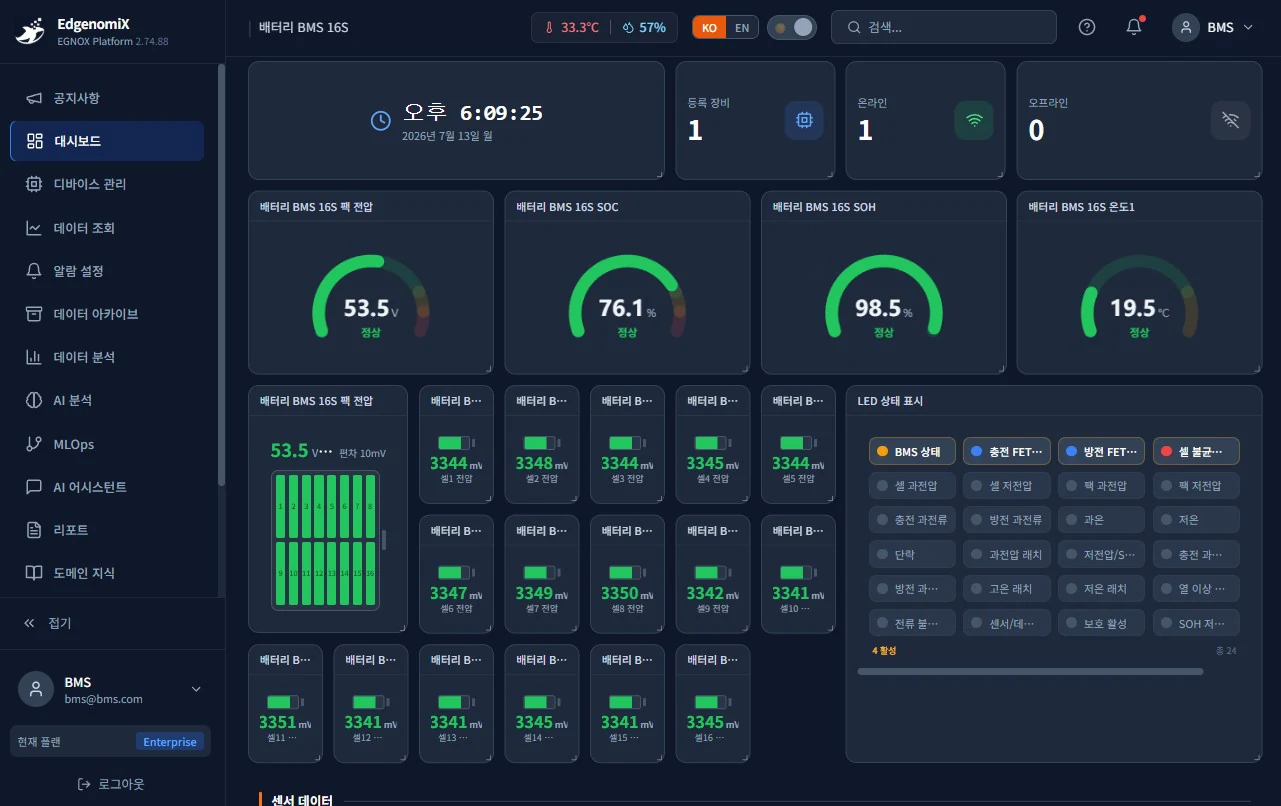
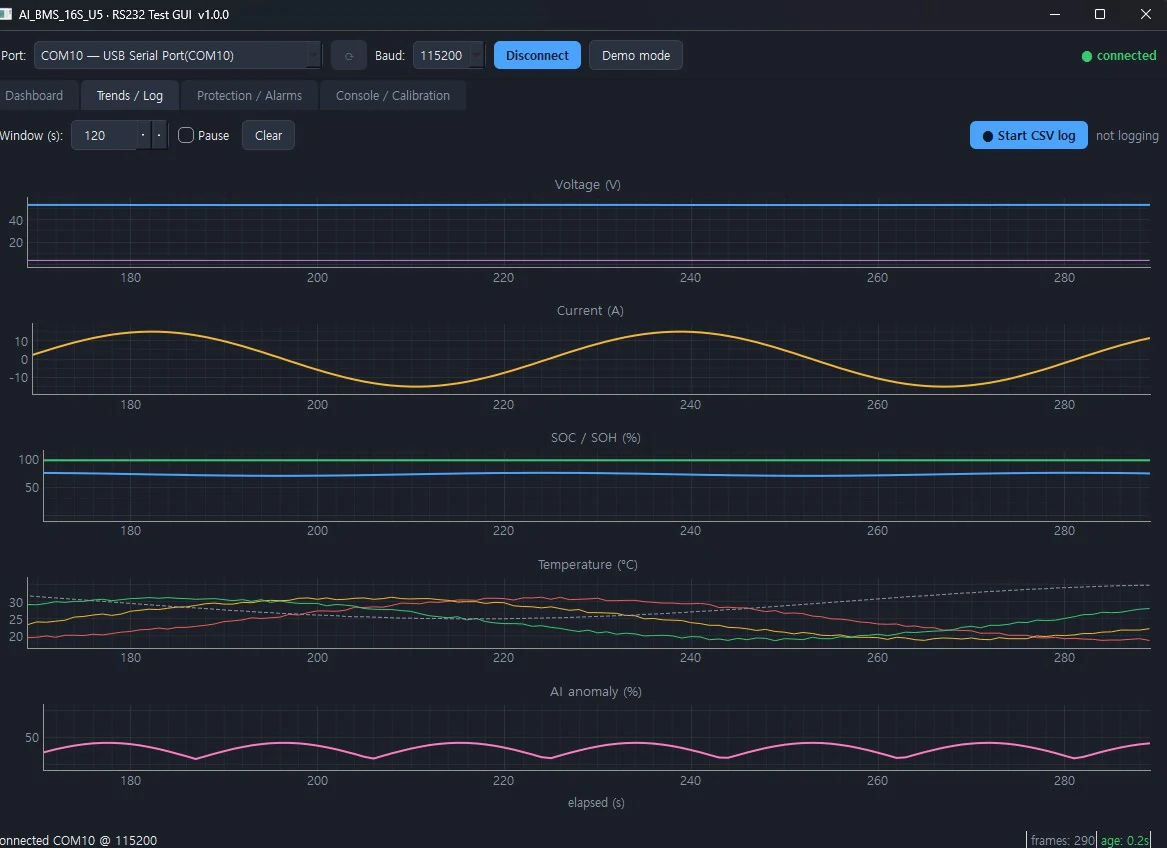
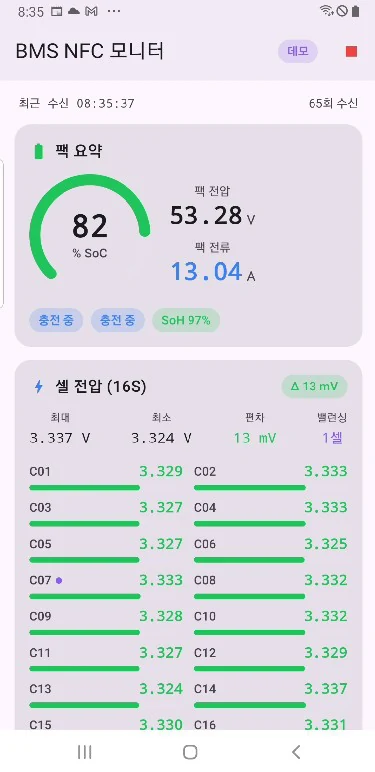
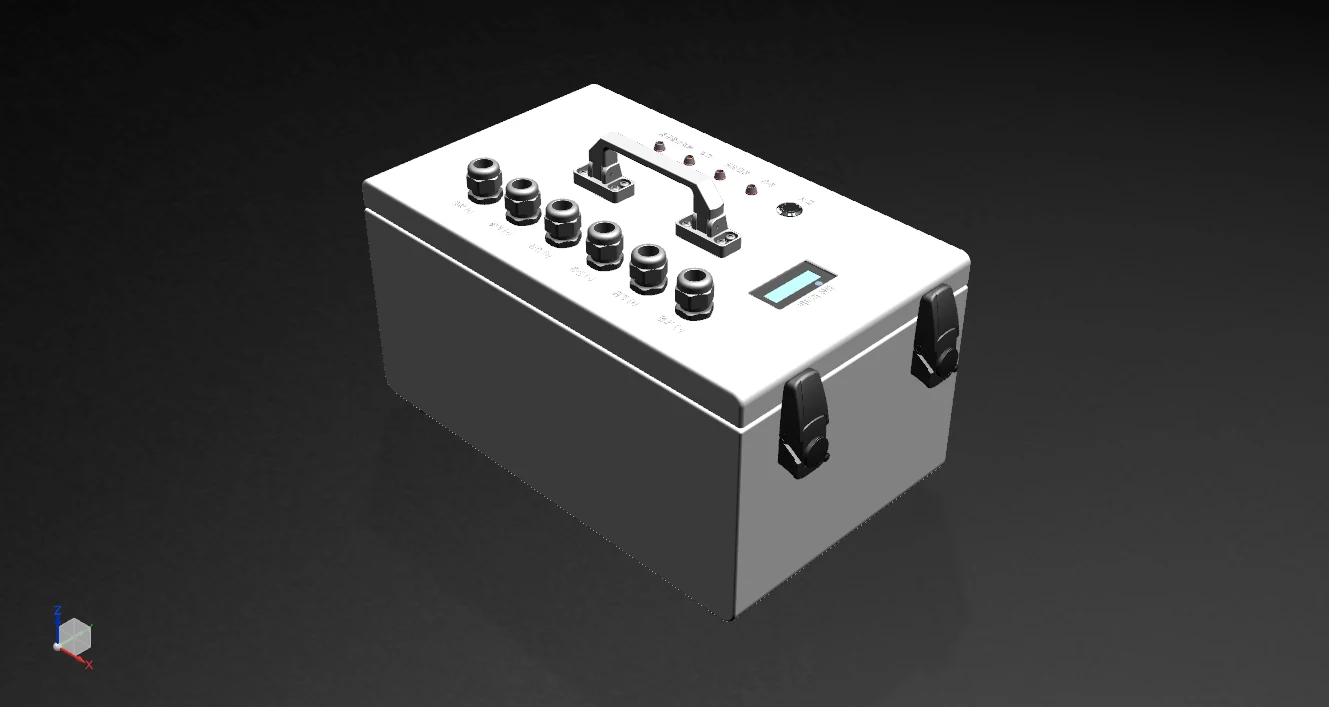
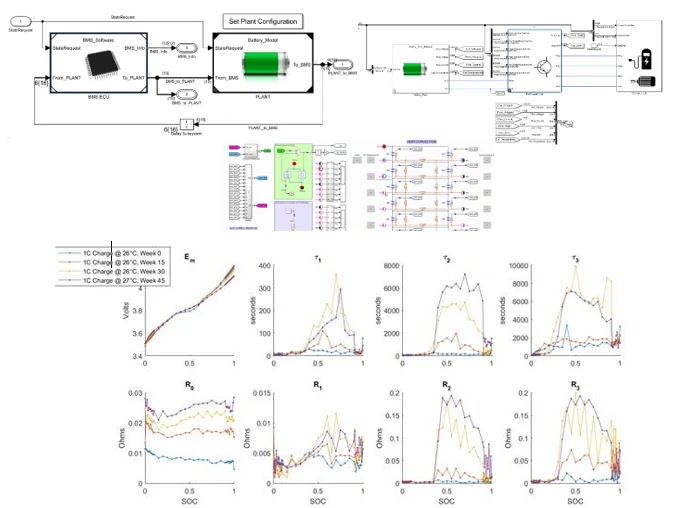
An independent Kalman filter on each of the 16 cells estimates remaining charge (SOC) and health (SOH) precisely even as load and temperature vary. It models LiFePO4's flat voltage plateau and hysteresis.
AI running inside the battery continuously watches for signs of cell imbalance, overheating, and sensor faults, and raises early warnings.
It publishes telemetry every second over standard MQTT so you can check multiple packs remotely from web or mobile. It supports RS232, MQTT, and NFC interfaces.
Overvoltage, overcurrent, and overtemperature protection and FET cutoff are handled solely by deterministic hardware logic; the AI and state estimation are supplementary information only.
Which projects this applies to
Custom development of a wireless vibration and temperature collection module
Development of a wireless vibration and temperature collection module attached to the outside of equipment. BLE-based battery-powered design enables installation without wiring. Integrates with EGNOX Edge HMI.
Interface board development for legacy equipment with non-standard communication
Custom interface board development for equipment with proprietary protocols that off-the-shelf gateways cannot connect to. Converts to Modbus and connects to EGNOX IoT.
Development of a vision inference board with built-in NPU
Development of a compact board that runs vision AI inference on the floor without the cloud. An optimized EGNOX Vision model is loaded onto the NPU. Direct camera connection design.
Development capabilities summary
| MCU/MPU platforms | STM32, ESP32, NXP i.MX, RPi CM, Nordic nRF |
|---|---|
| Communication interfaces | UART, SPI, I2C, CAN, RS-485, BLE, Wi-Fi, LTE |
| RTOS | FreeRTOS, Zephyr, Bare-metal |
| PCB design | Multilayer boards with 4 or more layers, high-speed signal design |
| Edge AI frameworks | TensorFlow Lite, ONNX Runtime, OpenVINO |
|---|---|
| Industrial environment support | Wide-temperature (-40 to 85°C), EMI/EMC, and IP-rated design |
| Certification support | Support for the KC, CE, and FCC acquisition process |
| Mass-production support | Prototype → low-volume production → high-volume production linkage |
Tell us briefly about
your project's purpose and the features you need
Share why off-the-shelf products fall short, your target specifications, and your budget and schedule range, and we will first outline the feasible development scope and our approach.